

 UTAH EDUCATION NETWORK

- PreK-12 Education
Essentials for Teachers
General Resources
Resources by Subject
- Higher Education
Tools for Higher Ed
Resources and Partners

Resources and services for Utah Higher Education faculty and students such as Canvas and collegEmedia. -
Community
Public Libraries
Parents
Career Ed
- Professional Development
UEN Courses
USBE Courses
Tech Discussions
- UEN-TV
Watch UEN-TV
Information
Local Productions

UEN-TV is operated by the Utah Education Network. Our goal is to educate, engage, and enrich the lives of Utah residents through broadcast programs and services. - Distance Education
On-Demand Support
800-863-3496, opt. 1, opt. 1
Mon-Fri 6:00 AM-10:00 PM
Or e-mail us: ivc-ops@uen.orgTraining Resources
- All Training Resources
- IVC Resources
- CMS Web App (CWA)
- WebEx Resources
- Zoom Resources
- Canvas Resources
Additional Info
Tools

The Utah Education Network (UEN) uses various systems and tools to deliver distance education classes to Utah students. - Network
Tech Services
(800) 863-3496Operations Center
801-585-7440
Staff DirectoryUEN Security Office
801-585-9888
Staff DirectoryTechnical Services Support Center (TSSC)
800-863-3496
Staff DirectoryProjects & Services
Network Groups
Network Tools
- About UEN
Information
- CARES Act
- Information Booklet
- Staff Directory
- Network Map
- Jobs
- Technical Advocates
- Software Licensing
Eccles Broadcast Center
101 Wasatch Drive
Salt Lake City, UT 84112(800) 866-5852
(801) 585-6105 (fax)UETN Governance
 More K12 Education
 my.uen Login
 Forgot my.uen Login
 Curriculum Search
 Find a School
 Canvas Logins
 Find an Institution
 Teacher Tips
 PD Newsletter
 PDTV
PDTV UEN Homeroom
 Adobe
Adobe Canvas
 eMedia
 Google
 Nearpod
 Utah's Online School Library
 Justin
 Braxton
 Dani
Dani Kayla
Kayla Katie
Katie Matthew
 Rob
Rob Val
Val UEN Print Schedule
 Monthly Highlights
 Give Us Feedback
 WebEx
WebEx Zoom
Zoom CMS Web App
 TMS
TMS YouTube
 Network Outages
 Network Traffic Map
 Speed Test
 Infrastructure Map
 Facebook
 Instagram
 LinkedIn
 News RSS
 Contact Us Form
 Dashboards
 Maps
Maps Widgets
 Interior Design 2
 Printable Version (pdf)
 Course Introduction
Core Standards of the Course
Strand 1
Students will review the elements and principles of design. (Interior Design 1 Strand 3, 4, 5, & 6) (Suggested 1-2 days)
Strand 2
Students will identify architectural features and styles.


Standard 1
Identify the American adaptations of housing styles and architectural features such as:
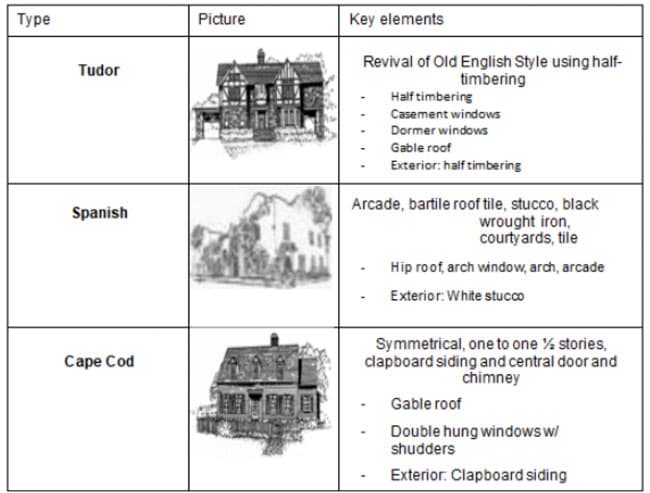
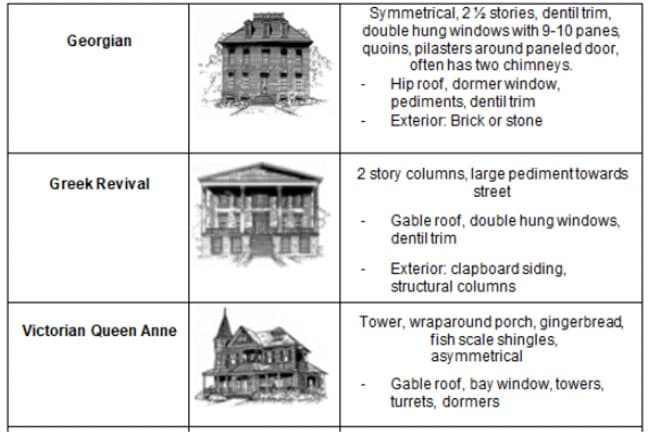
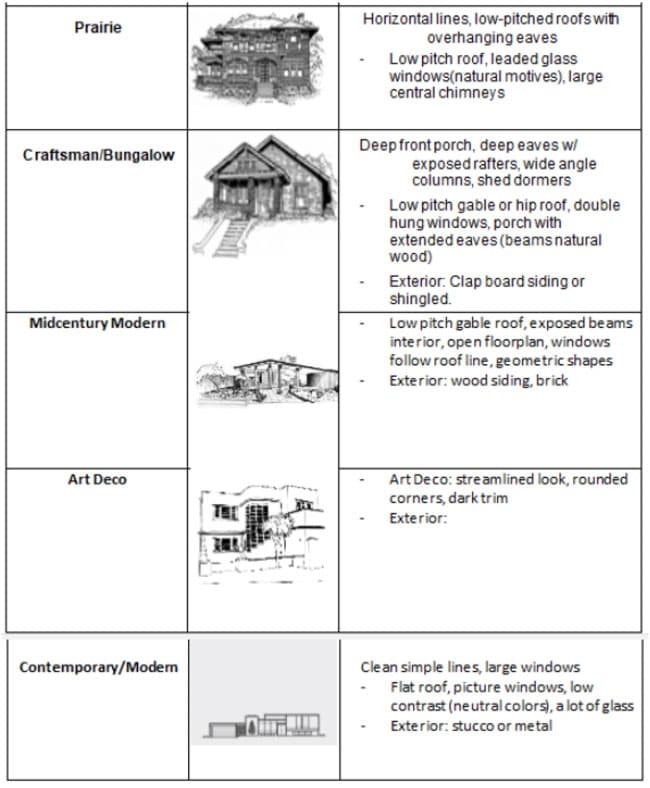
Performance Skills
Complete a project related to architectural styles and features. (Architectural tour, scavenger hunt, presentation etc…)
Strand 3
Students will understand components of construction documents - a set of plans that a builder uses.
Standard 1
The components of construction documents are the site plan, floor plan, interior and exterior elevations and the electrical plans.
-
Identify and discuss the site plan - a drawing of the building location on the lot
-
Identify and discuss the floor plan as a 2-D scaled drawing that shows the layout of the rooms with blueprint symbols.
-
Identify and discuss elevations as a 2-D representation of a given side of a building or inside wall details.
-
Identify and discuss the electrical plan which shows lighting, switches, outlets, TV, phone and computer outlets.
Performance Skills
Draw or draft a portion of a floor plan by hand or digital. Use a minimum of 3 attached rooms. (Can be commercial, residential, or use the FCCLA scenario.)
-
Use good line quality in ¼ inch scale.
-
Label each room, including room dimension and name.
-
Furnish each room using correct space planning guidelines.
-
Plan is neat and clean with professional lettering and a legend
Strand 4
Students will identify and explain various textiles.
Standard 1
Identify various textiles and factors that lead to the selection of specific textiles.
-
Identify natural textiles (cotton, linen, silk, wool) - come from plants or animals.
-
Identify manufactured textiles
-
Identify basic weaves and finishes (plain, twill, satin, Jacquard, purpose of finishes).
Weave Name Picture Description Characteristics Plain 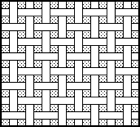
Formed by interlacing yarns one over, one under in regular sequence. Simple, basic weave that wears evenly. Twill 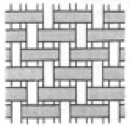
Formed by "floating" one warp thread over two or three weft threads, then under one. This creates a diagonal wale Produces a firm, strong fabric with a visible diagonal line. Satin 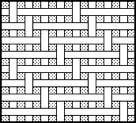
Formed by "floating" one warp thread over four or more weft yarns then under one thread. The order of interlacing is staggered so the result is a smooth face with no wales The floats give satin fabric its sheen. Jacquard 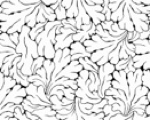
An intricate, variegated weave made by lifting any number of warp threads and any number of weft threads to create a woven pattern in the fabric. The weaves are created on a Jacquard loom.
Creates brocades, tapestries, and damask
Used for draperies and upholstery.
Strand 5
Students will identify and explain various flooring and wall treatments.
Standard 1
Identify floor treatments and factors that lead to their selection.
-
Discuss the characteristics of flooring types:
- Hard - durable, dent resistance, long lasting (wood - strip, plank, parquet; tile, ceramic tile, porcelain tile, and natural stone - marble, granite, slate, travertine)
- Engineered: similar to hard wood with a plywood underlayer, wears well, no gaps, no weather change, no need to refinish.
- Resilient - durable, wears well, returns to original shape after stress, quieter to walk on (vinyl)
- Luxury Vinyl Plank (LVP)
- Soft - hardest to clean, will wear out, made from woven fibers (carpet, rugs.)
- Hard - durable, dent resistance, long lasting (wood - strip, plank, parquet; tile, ceramic tile, porcelain tile, and natural stone - marble, granite, slate, travertine)
-
Discuss characteristics of carpet fibers
-
Discuss carpet terms and how they affect quality and selection--
Standard 2
Identify ceiling and wall treatments and factors that lead to their selection.
-
Paint is darker when dry. Choose a paint color that is slightly lighter than the one desired.
-
Discuss paint types
-
Discuss paint finishes
- flat - reflects very little light, least washable;
- eggshell - small amount of shine, more washable than flat;
- satin - smooth, velvety look with a bit more gloss, easy to keep clean;
- semi-gloss - used most in residences, subtle shine, very washable;
- High gloss - shiniest, most durable and easiest to clean but shows more imperfections on the wall
-
Discuss appropriate wallpaper and terminology
-
Discuss the various types of molding - strips of shaped wood used for trim or ornamentation in a room.
Standard 3
Identify window treatments and factors that lead to their selection. Identify the types of window treatments
-
Discuss window treatment considerations -
- direction of window: north - insulation, little light control; east - light control in a.m. south - a lot of light control, west - hot piercing light in p.m.
- light control: consider use of room (theatre, bedroom, etc.)
- shape of window: tall, narrow, arched, wide, short
- purpose of window: view, light, ventilation
- style of room: theme, décor, formality
- cost: wide range of prices
- maintenance: cleaning and care
- energy efficiency: keep heat/cold in or out
- privacy/security
-
Identify the types of window treatments
Treatment Image Definition 1. curtains 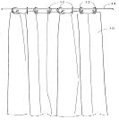
A piece of material suspended at the top to form a covering or screen, typically one of a pair at a window sheared or gathered onto a rod 2. draperies 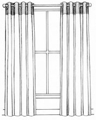
Cloth coverings hanging in loose folds. Pleated panels hung on a rod. Formal, heavier fabric. 3. shades 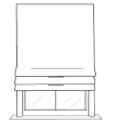
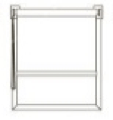
A single piece of material that is hung at the top of a window and that can be pulled down to cover the window 4. blinds 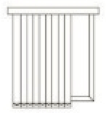
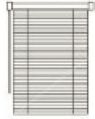
A series of evenly spaced slats that may be opened or closed by cords 5. shutters 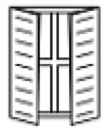
Vertical sections of wood hinged together, much like a folding door. The sections have crosswise slats called louvers, which vary in width 6. valances 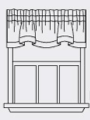
A short length of fabric placed across the top of a window
Standard 4
Discuss types and uses of light.
-
Discuss natural light.
-
Discuss types of artificial light.
- incandescent - gives a yellow glow to rooms, uses more energy than other lighting types
- fluorescent - gives a blue glow and diffused, shadow less light
- halogen - expensive but long-lasting, bright, white light, most like sunlight, very hot bulbs
- LED-light emitting diode - More expensive bulb but can last up to 25 years, no heat, consumes less energy, more cost effective.
-
Discuss the uses of artificial light.
- general - provides enough light so you can see everything in the room,
- ceiling - lights mounted on the ceiling including surface mounted, semi- surface mounted, pendants,
and chandeliers - recessed - light fixtures hidden in the ceiling such as can lights or eyeball lights
- wall - lights mounted on the wall such as sconces
- ceiling - lights mounted on the ceiling including surface mounted, semi- surface mounted, pendants,
- task - focus light on the area where it is most needed, used for close-up activities.
- strip - a series of bulbs mounted together in a line
- accent/decorative - provides a concentrated beam of light that focuses on a decorative object or area
- cove - a light placed just below the ceiling with a board or deflector beneath it
- portable - such as lamps or clip on lights
- track - lighting mounted on a metal strip that allows fixtures to be placed anywhere along the strip
- general - provides enough light so you can see everything in the room,
Strand 6
Students will distinguish features of selected furniture styles and characteristics of quality furniture.
Standard 1
Identify parts and features of furniture.
-
Identify examples of legs (cabriole, turned, tapered and splayed)
Type Picture Definition Cabriole 
A furniture leg that curves out at the middle and then tapers inward just above an ornamental foot. Turned 
Legs that have been shaped using various tools while a block of wood is spun on a lathe. Tapered 
A leg that becomes smaller and thinner towards the bottom. Splayed 
Legs that spread at an angle from the center of the piece.
-
Identify examples of feet (pad, bun, claw-and-ball, and bracket)
Pad 
Rounded flat pads or disks at the end of furniture legs Bun 
Rounded or balled feet. Ball and Claw 
Furniture foot fashioned to represent a bird's claw gripping a ball; often carved entirely of wood. Bracket 
A simple corner foot that can have an s-shaped curve or an l-shaped curve
-
Identify chair backs (ladder, splat, and shield)
Ladder 
A chair back with a number of horizontal slats like a ladder. Splat 
A chair back having a vertical wood panel in the center. Can resemble a vase of a fiddle. Shield 
A chair back having a form resembling that of a somewhat heart-shaped medieval shield.
-
Identify decorative features (finial, pediment, reeding, fluting, turning)
Finial 


A finishing ornament for a pediment, post, or spire. Pediment 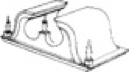
A decorative design detail adapted from architecture and applied to furniture. Reeding 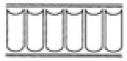
Rows of parallel convex beads used to embellish a leg. Fluting 
Rows of parallel concave beads used to embellish a leg. Turning 
Decorative spindles formed by turning a piece of wood on a lathe and cutting designs into the wood with a sharp knife as the piece spins.
Standard 2
Identify illustrations of chair types
-
Identify examples of chairs (Windsor, wing, side, & arm)
Wing 
A high-backed armchair with side pieces projecting from the back, originally in order to protect the sitter from drafts. Arm 
A chair with side supports for the arms or elbows. There may or may not be fabric or structure between the support and the seat portion. Side 
A straight-back chair without arms. Windsor 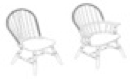
A wooden dining chair with a semicircular back supported by upright rods.
-
Identify examples of tables (gate-leg and pedestal)
Gate-leg 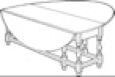
A table with one or two drop leaves that are supported when in use by a hinged leg swung out from the frame. Pedestal 
A table supported by a single central column.
-
Identify upholstered pieces (camelback, Lawson, tuxedo sofas and ottoman)
Camelback 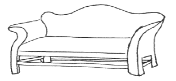
A sofa with a curved back, typically seen in more traditional styles like Queen Anne, Chippendale, or Federal. Lawson 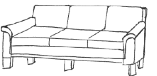
A sofa with a short, squared, overstuffed back and seat cushions; and rolled or squared arms that are lower than the back. Tuxedo 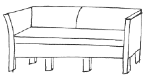
A streamlined type of couch with arms the same height as its back. Ottoman 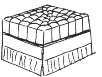
A low upholstered seat or footstool without a back or arms; the seat can be hinged to form a lid. Chesterfield 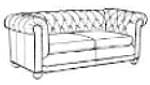
A tufted style, low sofa with rolled arms, no back cushions and often leather or velvet. Sectional / Modular 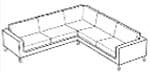
Consists of two or more joined sections that can be arranged in different configurations to fit a variety of room layouts. Mid-century Modern 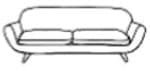
Minimalist designed sofa with clean lines and often square arms usually lower than the back.
Standard 3
Discuss construction techniques used in upholstered furniture.
-
Identify construction considerations used in upholstered furniture -
- Padding - for shaping, soften cushions, prolongs fabric life (batting, down)
- Springs -
- flat (used for less expensive furniture, not as durable)
- coil springs (used for higher quality furniture).
- Cushions (seams, welts and cording should be smooth, patterns should match, zippers should be sewn straight, sufficient padding, tightly woven fabric)
Standard 4
Identify case goods (buffet, high boy, secretary, wardrobe/armoire)
| Type | Picture | Definition |
| Wardrobe/armoire | 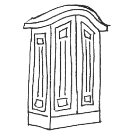 | A tall, freestanding cabinet with doors that hide shelves and drawers. There is also space for hanging clothes. |
| Secretary | 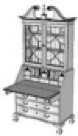 | A wood desk with a foldout top, drawers and a hutch with shelves for books. The hutch can have wood or glass doors. |
| Buffet | 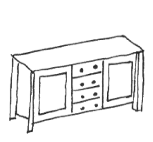 | A piece of furniture that has shelves and drawers, typically for storing dishes. Food can also be placed on the top for serving. |
| Highboy | 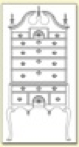 | A tall chest of drawers. Generally made in two separate pieces but not meant to come apart. The piece is supported by four legs. |
Standard 5
Discuss the construction techniques used in case goods (wood furniture used for storage).
-
Identify types of joints (butt, corner block, dove-tail, dowel, mortis and tenon, tongue and groove)
Butt Corner 
Dove-tail 
Dowel 
Mortis and tenon 
Tongue and groove 
-
Discuss the characteristics and uses of hardwoods (deciduous trees that lose their leaves: birch, cherry, mahogany, maple, oak, walnut.) - more durable and dent resistant, preferred for fine furniture.
-
Discuss the characteristics and uses of soft woods (coniferous cone-bearing trees: cedar, pine, redwood, spruce, cypress, fir) - can develop cracks and dents, less expensive.
-
Discuss and identify the various finishes - the process of embellishing and/or protecting the surface of a wooden material used on case goods
-
Discuss the use of manufactured lumber
- particleboard - made by combining chips of wood with resin and compressing the mixture to form a larger piece of wood
- plywood - made by laminating thin layers of inexpensive wood together, with the grain of each layer turned 90 degrees
- veneers - thin sheets layer of finished wood used as a top surface over other less expensive material in case goods
Performance Skills
Complete a project related to furniture styles and features.
Strand 7
Students will understand the elements of an appropriate visual presentation.
Standard 1
Students review the criteria for presentation boards. (See Interior Design 1 Strand 7 Standard 1) A presentation board is a visual representation used to sell the designer’s ideas to a potential client. It will show the following:
-
Colors scheme
-
Design ideas
-
Textures
-
Accessories
-
Fabric choices
-
Furniture choices & layout
-
Use a white or black board
-
Determine materials finishes and color schemes
-
Maintain good balance of positive and negative space
-
All graphics must be squared or rectangular, with straight edges.
-
Label with neat, architectural lettering and/or use an accurate key/legend
-
Professional boards should have major titles and samples backmounted with 1/8-1/4" contrasting borders.
-
All pictures (2-D) and samples (3-D) edges must be clean and secured well
-
Use the same background for all mounting.
-
Apply the principles and elements of design effectively in the layout.
Standard 2
Students create and practice a loose lay presentation. Select materials (flooring, paint, countertops, textiles, and hardware) to interchange and determine the desired design for a room based on a client profile.
Performance Skills
Students will design a presentation board and description for one or more rooms. (It is suggested students do the FCCLA STAR event scenario for Interior Design Board preparation)
-
Students will apply their knowledge of visual presentation
-
Include a variety of actual 3-D samples that illustrate the completed design. (i.e. wall coverings, floor treatments, window treatments, furniture covering, etc.)
-
Include 2-D pictures, photos, or visuals of the design (i.e., furniture, lighting, accessories, etc.)
-
Arrange an effective overall design of the visuals and samples.
-
Prepare and present an accurate oral or written description of the presentation board: Describe the style, the color scheme and the feeling/mood created.
-
Describe the focal point and the way it was emphasized.
-
Describe the balance (symmetrical, asymmetrical, radial) and rhythm (transition, repetition, gradation, radiation, opposition) and the way they were created.
-
Describe how harmony was developed in the design.
Workplace Skills
Students will practice the workplace skills below as an integrated part of the strands and standards in this course.
 http://www.uen.org - in partnership with Utah State Board of Education
(USBE) and Utah System of Higher Education
(USHE). Send questions or comments to USBE
Specialist -
Lola
Shipp
and see the CTE/Architecture & Construction website. For
general questions about Utah's Core Standards contact the Director
-
THALEA
LONGHURST.
These materials have been produced by and for the teachers of the
State of Utah. Copies of these materials may be freely reproduced
for teacher and classroom use. When distributing these materials,
credit should be given to Utah State Board of Education. These
materials may not be published, in whole or part, or in any other
format, without the written permission of the Utah State Board of
Education, 250 East 500 South, PO Box 144200, Salt Lake City, Utah
84114-4200.
http://www.uen.org - in partnership with Utah State Board of Education
(USBE) and Utah System of Higher Education
(USHE). Send questions or comments to USBE
Specialist -
Lola
Shipp
and see the CTE/Architecture & Construction website. For
general questions about Utah's Core Standards contact the Director
-
THALEA
LONGHURST.
These materials have been produced by and for the teachers of the
State of Utah. Copies of these materials may be freely reproduced
for teacher and classroom use. When distributing these materials,
credit should be given to Utah State Board of Education. These
materials may not be published, in whole or part, or in any other
format, without the written permission of the Utah State Board of
Education, 250 East 500 South, PO Box 144200, Salt Lake City, Utah
84114-4200.