

 UTAH EDUCATION NETWORK


 More K12 Education
 my.uen Login
 Forgot my.uen Login
 Find a School
 Canvas Logins
 Teacher Tips
 PD Newsletter
 PDTV
PDTV Adobe
Adobe Canvas
 eMedia
 Google
 Nearpod
 Utah's Online School Library
 Justin
 Dani
Dani Rob
Rob Val
Val Kayla
Kayla WebEx
WebEx Zoom
Zoom CMS Web App
 TMS
TMS YouTube
 Network Outages
 Network Traffic Map
 Speed Test
 Infrastructure Map
 Facebook
 Instagram
 LinkedIn
 News RSS
 Contact Us Form
 Dashboards
 Maps
Maps Widgets
San Juan Fiber Optic Infrastructure Project
Utah Connects a Final Frontier: White Mesa’s Advocate Helped UEN’s San Juan County Fiber Project Succeed
Griselda Rogers, Director of the White Mesa Education Center, played a critical role in helping Emery Telcom and UEN complete fiber-optic internet access to the town of White Mesa and beyond.
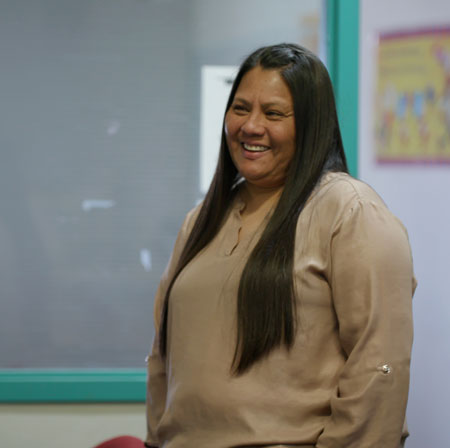 Griselda Rogers, director of the White Mesa Education Center, met with Ute Mountain Ute Tribe members for several years to help get rights of access for fiber-optic cable to connect the center to high-speed internet.
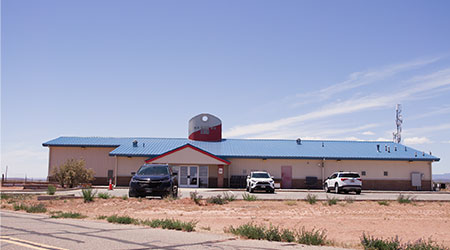 At the White Mesa Education Center, the communications tower that rises above the building connects the center to high-speed internet and supplies Wi-Fi to nearby businesses and agencies.
White Mesa, Utah, lies 320 miles southeast of Salt Lake City, a tiny town that’s part of the Ute Mountain Ute Tribe reservation. For years, residents faced a barrier that many other communities take for granted: reliable internet access. The lack of connectivity limited access to resources and educational opportunities. At the center of the community is the White Mesa Education Center, which provides a variety of educational, vocational, and community resources to the Tribe. Its director, Griselda Rogers, understood why a fiber-optic internet connection could be transformative for the community.
“It was just something that the community really needed,” Rogers said. So when the Utah Education Network (UEN) approached Rogers with the idea of running fiber to the education center as part of a larger San Juan County project, she got on board. “It was something that I had already worked on to try to get the services here.”
The first step was securing funding. One of the first things the center had to do to qualify for federal funding was to be certified as a public library, so they worked with the Utah State Library to accomplish that. Then, UEN helped them qualify for funding through the Universal Service Administrative Company (USAC) that would support the fiber buildout. But those steps were only the beginning.
Rogers and UEN advocate Jeff Egly petitioned the Tribe's tribal council for permission for the fiber project, which the council enthusiastically supported. “They were for it because we didn't have any infrastructure here for the community, for this center,” Rogers said. Reliable internet was essential for Tribe members to watch council meetings, read updates, and access tribal services.
Even with funding and leadership support secured, the most challenging task remained. The land in and around White Mesa is broken up into a lattice called “checkerboard allotments,” meaning that multiple individual landowners had to approve the project. For each parcel the fiber line would cross, a majority of residents needed to give permission. If even one allotment declined, the route would have to be redesigned. Rogers played a critical role in getting these signatures.
The terrain in the area is rocky and sometimes difficult to lay fiber through; routes also had to account for geography. While the team mailed permission forms to all residents affected, the forms alone weren’t enough to make many people feel comfortable with the project.
Rogers hosted meetings and went door-to-door to get all the required signatures for the project. She personally explained and advocated for the project, reassuring people who had concerns. “I would go to people’s homes and talk to them about it, because there was a lot of misunderstanding about how it works. They thought they were signing the land away, which they weren’t. They were only giving approval to let the line go through a little piece of their land.”
For several years before, during, and after the COVID pandemic, Rogers worked to accumulate all the needed signatures. It was a lengthy process, but the work paid off: White Mesa now has high-speed fiber to the education center, which has many downstream positive effects for the community.
“Now we have very good internet,” said Rogers. The White Mesa Education Center is connected to high-speed fiber internet, providing one of the fastest connections in the region. Students in the area can now engage in digital learning, including virtual reality-based education programs. “We partnered with Virtual Horizon Charter School and had students here doing schooling using their VR headsets. When they tested our internet, [the technician] said it’s probably one of the best and fastest connections he had worked on.”
With this foundation in place, the Tribe has obtained a federal grant to start making last-mile fiber connections to individual homes. What began as a single connection point is now creating opportunities for the entire community.
