

 UTAH EDUCATION NETWORK


 More K12 Education
 my.uen Login
 Forgot my.uen Login
 Find a School
 Canvas Logins
 Teacher Tips
 PD Newsletter
 PDTV
PDTV Adobe
Adobe Canvas
 eMedia
 Google
 Nearpod
 Utah's Online School Library
 Justin
 Dani
Dani Rob
Rob Val
Val Kayla
Kayla WebEx
WebEx Zoom
Zoom CMS Web App
 TMS
TMS YouTube
 Network Outages
 Network Traffic Map
 Speed Test
 Infrastructure Map
 Facebook
 Instagram
 LinkedIn
 News RSS
 Contact Us Form
 Dashboards
 Maps
Maps Widgets
American Indian Resources
Frequently Asked Questions - Dress Up
Question: Should I discourage dressing up as a Native American in my classroom?
A familiar story:
For years, classrooms across the country have included special days where students "dress up" as Native Americans for different celebrations and lesson activities. Here are two stories that may sound familiar to you.
BYU Arts Partnership Native American Curriculum Initiative (NACI) team member, Yvette May, shares the following story: “When I was seven years-old, a professional photographer dressed me up as the Hollywood version of an ‘Indian girl.’ This image was part of my first résumé photoshoot. It was commonplace then to dress up according to what we saw on TV or in advertising. My lack of understanding about what is respectful and appropriate in representing Native American culture changed as I became familiar with Native values and perspectives. As I have learned more, I have been able to be more respectful.”
NACI Project Manager Emily Soderborg also wore a paper bag vest and paper feather headband in connection with Thanksgiving in both her preschool and elementary school classes. “This was common during my childhood. I have since learned the importance of feathers in Native communities. I have seen feathers presented at graduation ceremonies, and talked with others about how they earned a feather. Feathers are symbolic of great deeds or outstanding leadership. Each feather that is worn must be earned. I have since learned that dressing up using a feather or a headdress diminishes the importance of feathers in Native cultures and reinforces a stereotype rather than giving an accurate representation.
As students prepare to dress up for Halloween or Thanksgiving, learn from past mistakes and know more so that you can help those around you avoid stereotypes that minimize a culture. Here are some helpful guidelines:
Native American regalia is not a costume:
Costumes are often used for entertainment and lack cultural significance. A costume is something one puts on to become something else, whereas regalia represents who a Native American individual is. It represents identity, honors ancestors, and symbolizes community. Through its deep cultural and personal meaning it becomes an extension of the individual. We don’t change who we are simply by changing what we wear.
Make a thoughtful and well-informed costume selection:
Halloween costumes that reinforce stereotypes are insensitive and promote false narratives. Changing your appearance to appear as another ethnicity, culture, or religion can lead to behavior that mocks others in disrespectful ways. Dressing up as a Native American gives students a generalized and inaccurate perspective on Native cultures and identities. Costumes diminish the vibrant cultures of Native communities across the country. Assuming goodwill from others is important, and asking thoughtful questions can support more informed decisions. The following questions, drawn from an article by Kim Tran, may offer helpful guidance. Her article provides additional clarity and deeper understanding.
- To what ethnic/racial/cultural group does the practice or artifact belong?
- How is the group that the practice or artifact belongs to oppressed?
- Do you benefit from doing this? How?
- Why might it make someone uncomfortable?
- What makes it possible for you to engage with this practice, tradition, or material? How did you come to acquire the artifact or elements of the practice?
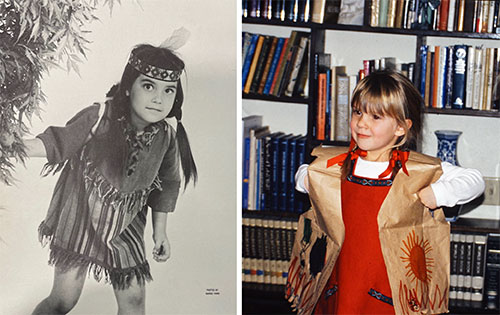
Costume of an "Indian girl" and a common classroom activity of dress-up.
What should teachers know about non-Native students wearing the regalia of Indigenous Peoples as costumes?