

 UTAH EDUCATION NETWORK


 More K12 Education
 my.uen Login
 Forgot my.uen Login
 Find a School
 Canvas Logins

 Teacher Tips
 PD Newsletter
 PDTV
 Adobe
 Canvas
 eMedia
 Google
 Nearpod
 Utah's Online School Library
 Justin
 Dani
 Rob
 Val
 Kayla
 WebEx
 Zoom
 CMS Web App
 TMS
 YouTube

 Network Outages
 Network Traffic Map
 Speed Test
 Infrastructure Map
 Facebook
 Instagram
 LinkedIn
 News RSS
 Contact Us Form
 Dashboards
 Maps
 Widgets
Cultivating the Future: UEN Helps Springville Library Increase Internet Speed 10X
Enhanced connectivity gives the library a greater capacity to serve patrons today and in the years ahead.
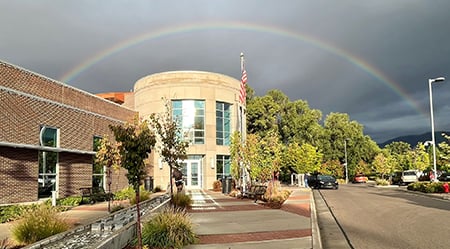
A rainbow arcs over the roof of the Springville Public Library. Light also powers the fiber-optic network that connects the library to the internet, now upgraded to a 10 Gbps connection.
Springville, Utah, is nicknamed “the Art City” for its dedication to art and culture, both historic and current. Its new library, opened in 2011, continued a library tradition begun with a Carnegie library built more than 100 years ago. Continuing this commitment to the past while meeting the needs of the future, the library upgraded its internet service this year, with assistance from the Utah Education Network (UEN).
Springville Public Library has continued to see increased internet usage from patrons during the past several years. A growing number of devices connect to its network through on-site computers or through its Wi-Fi network. It had been running a 1 Gbps connection that still served patron needs, but library leadership wanted to be proactive rather than wait until bandwidth began affecting patron service.
“Many of the computer uses now by patrons are fairly demanding in terms of bandwidth,” said Library Director Dan Mickelson, “so upgrading to 10 Gbps gives us significantly more capacity for growth and will allow us to increase some of the per-device bandwidth limits we currently have in place.”
In late summer, UEN contacted the Springville Public Library to let them know they were ready to begin. As UEN Network Engineer Dan Mills explained, libraries like Springville that have existing service receive upgrades later in the year than facilities that need new service. During this window, UEN can improve services and help libraries prepare for future needs.
They established a day and time before the library opened where they could remove the old hardware, install the new hardware, and logically swing the library’s connection at UVU from 1 Gbps to 10 Gbps. “The coordination, planning, and configuration work for changes take some time to square away and prepare for,” Mills said. “However, once we are scheduled, the actual cutover process takes very little time.” Mickelson agreed, explaining that outside one small hiccup that required restarting a device, the actual cutover took only about 30 minutes.
Mills explained that during those 30 minutes, the team performs the actual physical installation and cabling of equipment, verifies that they have good light levels on the fiber interfaces, and ensures clean interfaces for traffic passing without errors. Technicians then verify with the customer that what they expect to be working is indeed working properly.
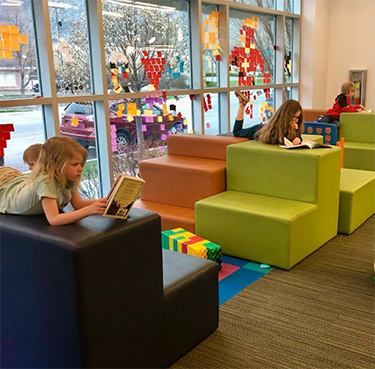
Tweens and teens can enjoy analog and digital resources inside the library.
The library is still upgrading some of its downstream network components and devices so it can take full advantage of the 10 Gbps connection. “Even with that work still underway, the additional bandwidth has improved our network backbone, and we have seen faster internet performance across the board,” said Mickelson. As the library completes the remaining infrastructure improvements, Mickelson expects to make even better use of the increased capacity and provide more bandwidth to individual devices.
The upgrade gives the library the capacity and flexibility to continue improving service while enhancing its network backbone and infrastructure. These improvements will help the library support growing patron demand, provide better bandwidth to connected devices, and accommodate future services without the internet connection itself becoming the limiting factor. “Overall,” said Mickelson, “this was a proactive investment in the library’s future capacity.”
